

- Protocol standards for secure cross-system interoperability
- Infrastructure such as relayers that transport messages between connected systems
- Reusable applications for common interoperability use cases, including token transfers and General Message Passing (GMP) for cross-chain contract calls
- Flexible verification mechanisms, ranging from trust-minimized light clients to permissioned attestation-based models
IBC layers
IBC is organized into three layers: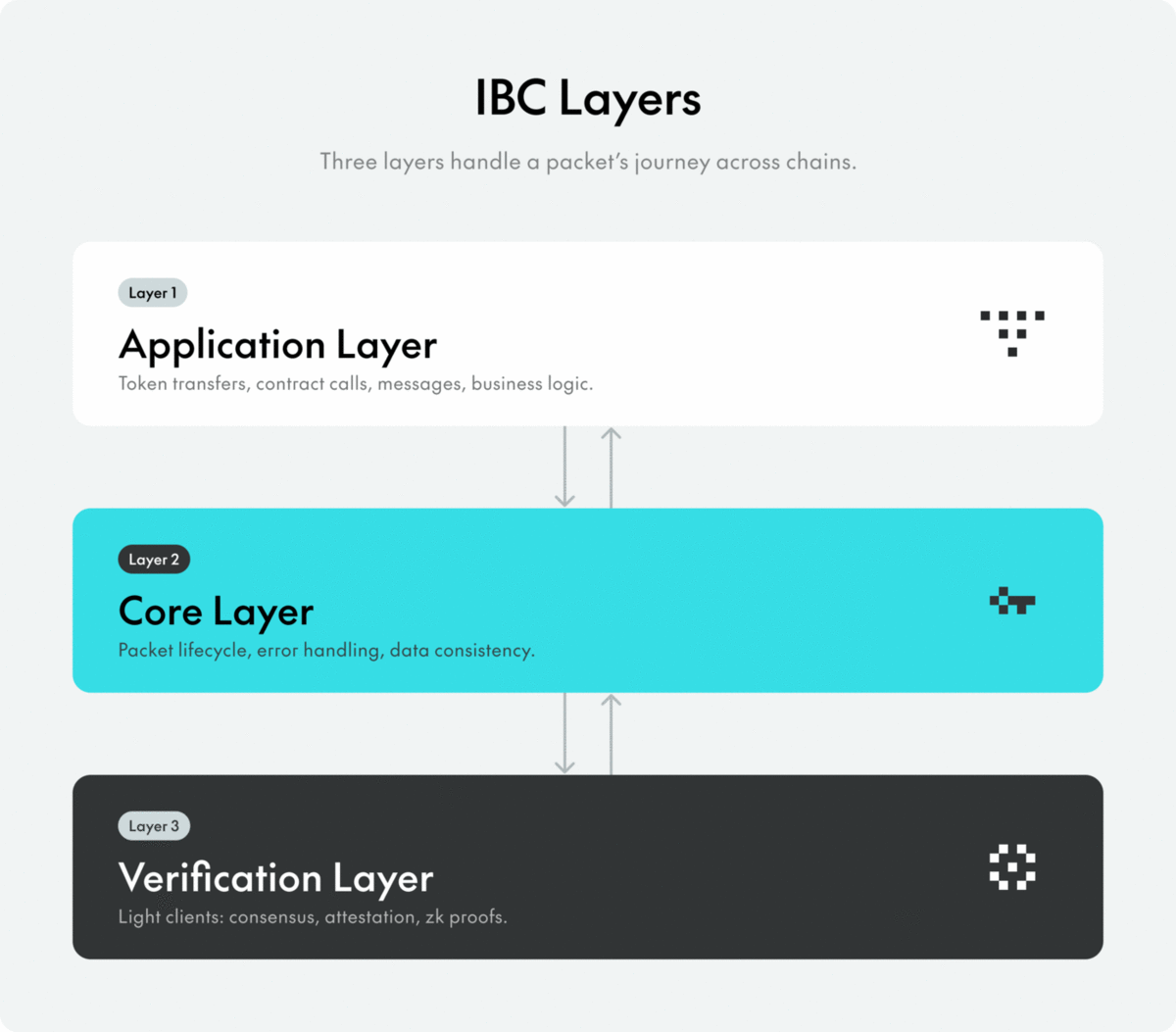
Why IBC?
Blockchain networks have multiplied, and the ledgers behind them now need to transact with each other securely. IBC is the open standard for that, with no third party between the two networks.Direct communication and verification
IBC enables systems to communicate directly with one another through self-hosted infrastructure. Connections are peer-to-peer and rely on no third-party intermediary or external validator network; each side verifies cross-system messages against the counterparty’s state. A ledger using IBC keeps its own security model, which simplifies the risk surface and reduces external dependencies.Proven in production
IBC has run in production for more than five years, connecting 115+ public networks alongside private networks and consortia, and has processed $50B+ in volume with no exploit of the supported version. Every layer has been independently audited.Customizable at every layer
IBC makes no assumptions about what it connects. The standards can be implemented in any language, on any network able to produce the verification a counterparty requires, and each layer can be adapted independently. Applications can be anything: adopt the standard modules, ICS-20, GMP, and IFT, or write your own, which needs only to implement a minimal interface and register with the router under a port identifier. Today IBC spans EVM networks including Ethereum and Besu, Cosmos chains, and Solana.Flexible verification
IBC supports multiple trust models to meet different business and regulatory needs.- Consensus light client verification provides trust-minimized security by verifying messages directly against signed consensus data, as the Besu QBFT and IBFT 2.0 light clients do for enterprise EVM networks.
- Attestation-based verification enables organizations to leverage existing governance processes, compliance frameworks, and first-party key infrastructure.